
Data preprocessingClean-up of deficiencies, anomalies, duplications and unit inconsistencies
AI Machine Learning
Machine Learning Prediction
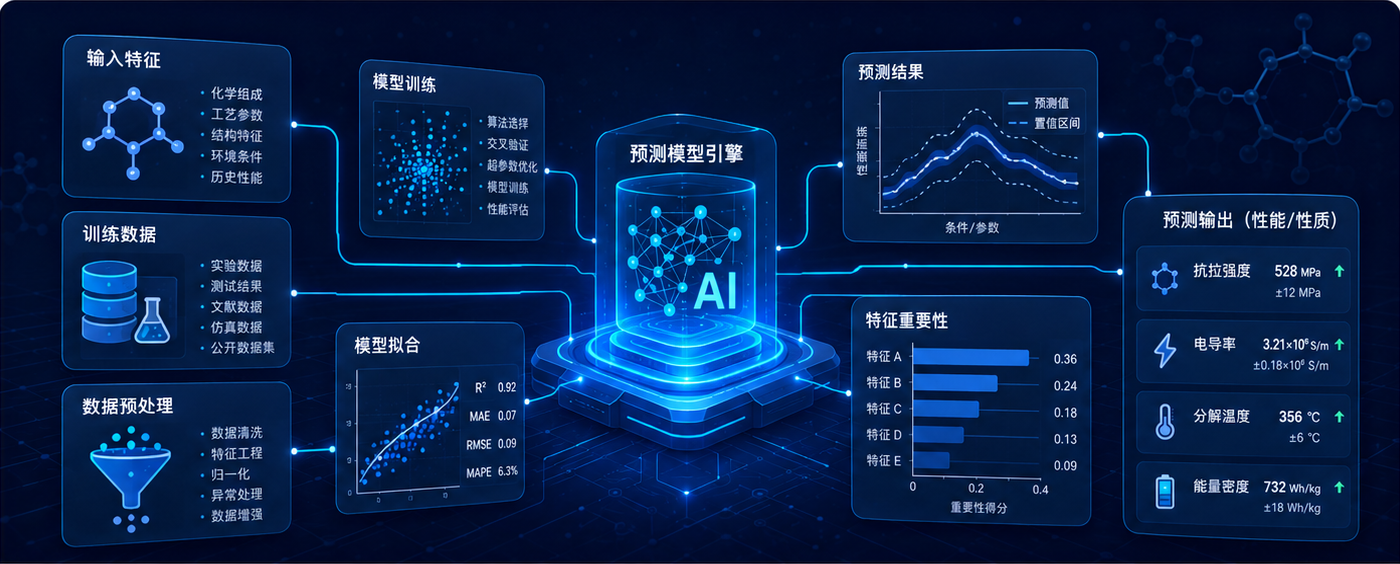
Development of predictive models around structures, processes, components, experimental conditions and performance indicators, supported by interpretable results for screening, assessment and scientific decision-making.
01
Solution Overview
Establishment of a mechanical learning prediction process for scientific experiments, material performance, molecular properties, process parameters and test results, from pre-processing of data, feature engineering, modelling training, cross-certification to interpretation analysis. Projects could be used for small sample exploration, mass screening, risk identification and forecasting tool development.
Model developmentReturn, classification, sequencing and uncertainty assessment
Performance assessmentCross-certification, external validation and error analysis
Interpretation analysisDescription of key variables, sensitivities and scope of application
02
Applications
- Material performance, reaction rate, adsorption capacity and stability projections
- Modelling of the properties of drug molecules, catalysts, polymers and functional materials
- Non-linear relationship analysis between experimental conditions and target indicators
- Limited data available, prior feasibility assessment and model baseline required
- Desiring to encapsulate the predictive model as an internal query tool or web application




03
Overall process
Evaluation indicators
Feature Build
Parameter Optimization
Cross-validation
Scope of application
Web Interface
04
Technical modules
- Feature Project:Explanatory features based on molecular, material, process or experimental conditions.
- Model combination:Select linear models, tree models, nuclear methods, neural networks or integrated learning by data scale.
- Certification system:Set up training/certification/test splits, cross-certification and external sample validation.
- Uncertainty assessment:Output creditable interval, abnormal sample tips and scope description.
05
Project value
Rapid establishment of baselinesTo judge whether the data available are sufficient to support the prediction mission
Improved screening efficiencyBatch projection and prioritization of candidate samples
Risk reduction in decision-makingIdentification of high-risk results using error analysis and uncertainty
Facilitation of follow-up deploymentModels can be encapsulated as scripts, web pages or internal tools
 AI / Simulation
 Characterization / Supplies